


GMKtec EVO-X2 vs. NVIDIA DGX SPARK: Local AI Performance Benchmark

GMKtec EVO-X2 vs. NVIDIA DGX SPARK: Local AI Performance Benchmark
As local large language models (LLMs) become increasingly vital for content creation, coding, and enterprise intelligence, Mini PCs are stepping into a new era of AI computing.GMKtec’s EVO-X2, powered by the AMD Ryzen™ AI platform, has been benchmarked against NVIDIA DGX SPARK to test real-world local AI capabilities.
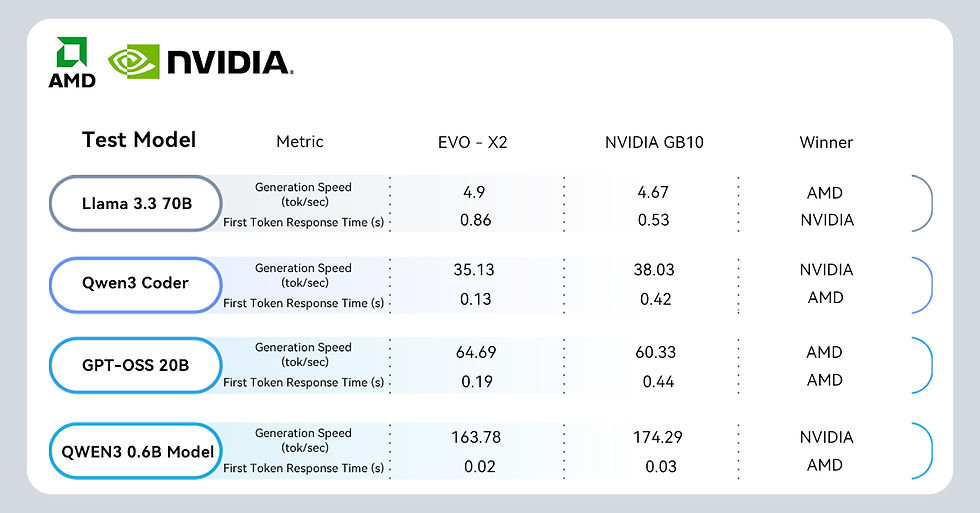
The evaluation covers four popular open-source models, Llama 3.3 70B, Qwen3 Coder, GPT-OSS 20B, and Qwen3 0.6B, comparing generation speed (tokens/sec) and first token response time (s) across both devices.
⚙️ Performance Insights
Across the tests, GMKtec EVO-X2 demonstrates remarkable efficiency in handling local AI workloads.
For medium to large models (20B–70B), the EVO-X2 consistently delivers faster generation speeds, particularly excelling in the GPT-OSS 20B and Llama 3.3 70B benchmarks.
In first-token latency, EVO-X2 achieves significantly lower response times in multiple models, showcasing AMD’s optimized memory bandwidth and local AI acceleration architecture.
🚀 Why EVO-X2 Excels in Local AI
AMD Ryzen™ AI EngineHarnesses dedicated AI acceleration for multi-threaded, low-latency inference performance.
Open Ecosystem CompatibilityFully supports major open-source AI models (Llama, Qwen, Mistral) and frameworks (Ollama, LM Studio, vLLM).
Superior Performance-to-Power RatioDelivers workstation-level AI capability within a compact Mini PC form factor, with exceptional energy efficiency.
Local AI Workflow ReadyDeploy and run models directly on-device — no cloud dependency, enhanced data privacy, and instant responsiveness.
🧠 Conclusion
The results prove that GMKtec EVO-X2, powered by AMD, competes head-to-head with NVIDIA’s DGX SPARK — even surpassing it in several key performance areas, especially in real-world latency and response efficiency.
Compact in size, powerful in intelligence, EVO-X2 redefines what’s possible for local AI computing.


8xbet làm mình chú ý ở cách chia bố cục, nhìn qua khá dễ nắm chứ không phải dò từng chỗ mới biết nội dung nằm ở đâu. Mình thường chỉ lướt sơ giao diện trước, chưa xem kỹ từng mục nên cũng không có gì để nhận xét sâu hơn. Riêng phần trình bày thì thấy khá gọn, các khối nội dung tách nhau rõ nên lúc kéo trang vẫn theo dõi được. Mình thích kiểu sắp xếp đơn giản như vậy hơn là nhét quá nhiều thứ vào cùng một chỗ, nhìn đỡ ngợp hẳn. Menu cũng nằm ở chỗ dễ thấy, còn các nhóm nội dung bên dưới được chia thành từng khối riêng, không bị lẫn…
GO8 mình mới ghé xem sơ qua, chủ yếu tò mò giao diện chứ chưa tìm hiểu nội dung bên trong. Lúc đầu cứ nghĩ chắc phải nhìn một hồi mới biết mục nào nằm đâu, nhưng cách chia nhóm trên trang khá dễ theo dõi. Mình thường ngại mấy trang dồn mọi thứ sát nhau, kéo một đoạn là quên vừa xem gì, nên bố cục tách thành từng khối thế này nhìn cũng nhẹ mắt hơn. Có chút thời gian nên mình bấm qua lại vài mục, thấy menu dễ tìm, không phải quay về đầu trang rồi dò lại từ đầu. Mình chưa xem kỹ hơn nên cũng chỉ nói được chừng đó thôi. Phần menu và…
tg88 có cách chia nội dung khá dễ theo dõi, nhất là lúc mình chỉ muốn đọc lướt để biết trang đang nói về gì. Mấy tiêu đề riêng giúp mình tìm được đoạn cần xem mà không phải kéo lên kéo xuống nhiều lần. Mình thích kiểu trình bày rõ ràng vậy hơn là gom mọi thứ vào một bài dài, đọc một lúc lại quên đang ở phần nào. Phần giới thiệu nền tảng và phần danh mục giải trí được để riêng nên cũng đỡ lẫn giữa thông tin chung với nội dung cụ thể. Không cần đọc hết một lượt vẫn biết chỗ nào có thể quay lại xem kỹ hơn, khá tiện nếu đang tranh…
tg88 dạo này mình thấy có người nhắc tới khi nói về các nền tảng giải trí trực tuyến nên cũng thử mở vào xem cách họ bố trí giao diện ra sao. Mình không đi sâu vào nội dung hay từng trò cụ thể, mà chủ yếu quan sát cách các chuyên mục được phân chia trên trang và cách thông tin hiển thị cho người dùng. Nhìn tổng thể thì các khu như thể thao, casino, game bài hay slot thường được sắp xếp theo từng nhóm khá rõ, hiển thị dạng khối và danh sách nên lướt qua cũng dễ theo dõi. Các bảng dữ liệu được trình bày dạng cột khá gọn, giúp quan sát nhanh…
JW88 có phần giới thiệu chia theo từng tiêu đề như vậy thì đọc cũng dễ nắm ý hơn, nhất là với người chỉ muốn xem sơ trang này nói về gì. Mình thường ngại những trang gom hết thông tin vào một đoạn dài, kéo mãi vẫn không biết đang đọc tới đâu. Ở đây, chuyện nền tảng bắt đầu từ năm 2022 được để trong phần hành trình phát triển nên có chút bối cảnh, không chỉ toàn nói về sản phẩm. Mình thấy cách tách nội dung như vậy khá hợp với kiểu đọc lướt, muốn tìm hiểu phần nào thì dừng lại ở phần đó, không cần đọc hết từ đầu. Riêng các tiêu đề về…